Here is a photograph submitted by Ed Essert of the MMC in 1956! (click o the picture for a bigger view)

Madison Maennerchor in 1956
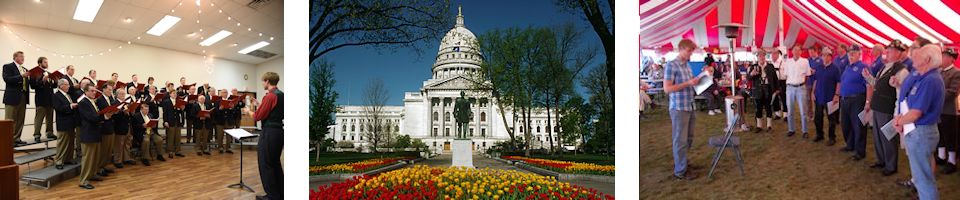
Here is a photograph submitted by Ed Essert of the MMC in 1956! (click o the picture for a bigger view)
Madison Maennerchor in 1956
The Madison Männerchor was honored by the Lescrenier family by being invited to sing at the Celebration of the Life of Charles Lescrenier. Rev G. Keith Schroerlucke presided. Charles and Peggy were long-time MMC associate members. We welcome Peggy’s continued support. The funeral was at Ryan Funeral Home (2814 N. Sherman Ave. Madison, Wisconsin). We sang Heimat (requested by the family), Morgenrot, and Beautiful Savior. About 25 MMC singers were present. John Mysliviec directed. June 4, 2011.
The more we heard of Charles Lescrenier’s life, the more we realized how many peoples’ lives he touched and in how many positive ways. It was indeed an honor to be present.

Charles Lescrenier
The obituary, prepared by the Joyce-Ryan Funeral home can be viewed at this link.
You are cordially invited to
Madison Männerchor’s
159th Annual SPRING CONCERT
John Mysliviec, conductor
Saturday, May 14th, 2011 at 7:00 p.m.
Madison Turner Hall, 3001 S. Stoughton Rd.
The Milwaukee Damenchor, our guest choir, will sing at intermission! After the concert, listen and dance ’til 11 p.m to Jerry Steuber’s musical delights!
Concert Tickets
$8 at the door and children under 16 are admitted free.
click here > Register < click here
(pay on line securely by credit card or pay at the door)
A German light supper will be available a la carte following the concert. The cash bar will be open throughout the evening.
See you there!
It began with the Royal Wedding on 12 October 1810.
Crown Prince Ludwig, later to become King Ludwig I, was married to Princess Therese of Saxony-Hildburghausen on 12 October 1810. The citizens of Munich were invited to attend the festivities held on the fields in front of the city gates to celebrate the happy royal event. The fields were renamed Theresienwiese (“Theresa’s Fields”) to honor the Crown Princess, although the locals have since abbreviated the name simply to “Wiesn”. Horse races in the presence of the royal family marked the close of the event that was celebrated as a festival for the whole of Bavaria. The decision to repeat the horse races in subsequest years gave rise to the tradition of Oktoberfest.
The Oktoberfest continues in 1811.
In 1811, an added feature to the horse races was the first Agricultural Show, designed to boost Bavarian agriculture. The horse races, which were the oldest – and at one time – the most popular event of the festival are no longer held today. But the Agricultural Show is still held every three years during the Oktoberfest on the southern part of the festival grounds.
More and more things to see and do.
In the first few decades, the choices of amusements were sparse. In 1818, the first carousel and two swings were set up. Vistitors were able to quench their thirst at small beer stands, which grew rapidly in number. In 1896 the beer stands were replaced by the first beer tents and halls set up by the enterprising landlords with the backing of the breweries. The remainder of the festival site was taken up by a fun-fair. The range of carousels offered was already increasing rapidly in the 1870’s as the fairground trade continued to grow and develope in Germany.
Today, the Oktoberfest in Munich is the largest festival in the world, with an international flavor characteristic of the 20th century.
At the foot of the Bavaria Statue, adjacent to the Huge Oktoberfest grounds there are also carousels, roller coasters and all the spectacular fun for the enjoyment and excitement of visitors of all ages.
The festivities are accompanied by a program of events, including the Grand Entry of the Oktoberfest Landlords and Breweries, the Costume and Riflemen’s Procession, and a concert involving all the brass bands represented at the “Wiesn”. 2010 marks the 200th anniversary of this tradition!.
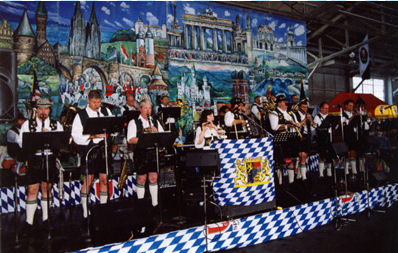
An Oktoberfest Band
We paid our annual respects to our deceased members today, singing at Roselawn Cemetery, Madison WI, and at St Mary Lake Cemetery, Westport. Continue reading
The Madison Männerchor congratulates the Max Kade Institute on its anniversary this month.
Historical information is available that tells the story of the founding Max Kade Foundation of New York, and the UW Max Kade Institute.
Members of the Madison Männerchor met at the Madison Essen Haus to celebrate and sing during the Oktoberfest. A good time was had by all, despite the drizzly weather.
Essen Haus
Thanks go to Tim Hughes for continuing the archiving tradition for the MMC.
The Madison Männerchor historical documents from 1871-1978 can be found in the Wisconsin Historical Society records, under call number Mss 496. The compilation consists of 4 boxes of archives. You can reach the “Finding Aid” at this link. Continue reading
Stopped cold in amazement! While casually searching on line for the archives of Männerchöre that were established at about the same time as our own, I came across the Indianapolis Männerchor Archives that are housed by the Indiana University-Purdue University Ruth Lilly Collections and Archives. Continue reading
In Jennifer Ludden’s article, “In Rural Wisconsin, German Reigned for Decades,” she interviews Mel Grulke about speaking German at home. There is also a Walk Through Hustisford in this article.
Jennifer also includes her audio report.
Please check out the interview.